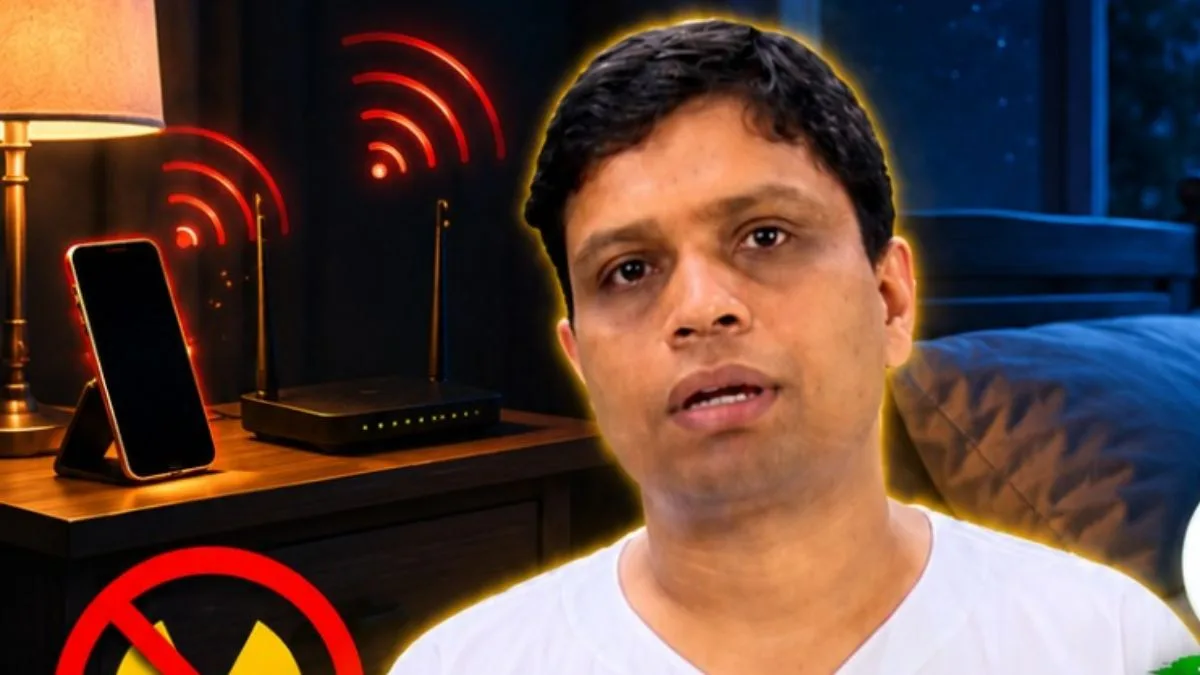
Acharya Balkrishna recently told his followers to switch off the TV from the main switch before sleeping, not just with the remote. He also advised keeping phones at least one metre away from the bed. It sounds like casual wellness advice. But the science behind it is more solid than it may seem.
Advertisement
What happens when you leave the TV on standby
Most people think pressing the remote’s power button turns the TV off. It does not. It puts the device into standby mode. In standby mode, many smart TVs maintain a wireless connection, meaning they continue emitting radiofrequency radiation to stay ready for updates and commands.
Even in standby, these devices can continue to emit EMFs as they maintain a network connection. Turning off devices at the power source when you finish using them stops these emissions entirely. This is exactly what Balkrishna was pointing at. The only way to fully cut off emissions is to cut the power supply itself.
The Wi-Fi signal from a TV continues to emit into the room even when the TV is on standby mode. Plugging the TV into a surge protector and switching that off when you are done watching is one practical solution.
Are these rays actually harmful?
This is where things get more nuanced. Not all radiation is the same. Non-ionising EMFs present low-level radiation that is generally perceived as harmless to humans. Ionising EMFs, on the other hand, produce high-level radiation with the potential for cellular and DNA damage. TVs and smartphones emit non-ionizing radiation.
According to the WHO, extremely low frequency and radiofrequency EMFs are unlikely to cause adverse health effects. However, some scientists question whether enough research has been done into long-term safety.
The debate is still open. What science is more certain about is what happens to your sleep when these devices are nearby at night.
How phones disrupt your sleep cycle
The problem with phones near your bed is not just about radiation. It is about light, behaviour, and biology working against you at the same time.
A variety of scientific studies have shown that blue light exposure before bedtime can create circadian disruptions and inhibit melatonin secretion in the brain, which ultimately results in deteriorated sleep quality and duration.
Melatonin is the hormone your body produces to signal that it is time to sleep. Screens interfere with this signal.
Experimental studies show that even short periods of evening tablet or smartphone use significantly reduce melatonin and shift its onset, resulting in later bedtimes and shorter sleep duration. Blue light after dusk exerts a potent alerting effect, reinforcing wakefulness and circadian misalignment.
Research on adolescents and young adults found that avoiding smartphone use in the last hour before bedtime is advisable to prevent sleep disturbances. Adults showed a reduction in deep sleep during the first part of the night when using phones without blue-light filters before bed.
The stress and depression connection
Poor sleep does not just make you tired. It sets off a chain of mental health consequences.
Chronic exposure to blue light may cumulatively contribute to insufficient and irregular sleep, with adverse consequences for cognition, mood, and metabolic health.
Research has consistently found links between phone use at night, poor sleep, and mental health. Studies consistently link excessive smartphone use to poor sleep quality, depression, anxiety, and stress.
A 2023 study published in Frontiers in Public Health examined 514 university students and found that smartphone addiction affected sleep quality, with depression and stress acting as key mediating factors in that relationship. The pattern is a loop: poor sleep feeds low mood, and low mood feeds more late-night scrolling.
Blue light from devices has been found to be a growing culprit behind bad sleep. The proliferation of LED lighting and screen exposure has been linked to vision deterioration, circadian disruption, and mood disorders.
What the distance advice is based on
Balkrishna’s advice to keep the phone at least one metre away is not arbitrary. The physics of electromagnetic fields supports this. The intensity of electromagnetic fields decreases rapidly with distance, following the inverse square law. This means that doubling your distance from your TV reduces your exposure to roughly one-quarter of its original strength.
Putting the phone across the room rather than under your pillow meaningfully lowers your exposure. It also makes it harder to reach for the device at 2 AM, which removes the behavioural trigger entirely.
What you can practically do
The advice holds up whether you approach it from an EMF concern or a sleep hygiene angle. Switch off the TV from the power strip at night. Keep the phone outside the bedroom or at minimum on the far side of the room. Avoid screen use for at least an hour before bed. These steps are low-cost and have real research behind them.
The science does not fully agree on how dangerous non-ionizing radiation is in the long run. But it does agree on one thing. Screens near your bed at night are bad for your sleep. And bad sleep is bad for almost everything else.